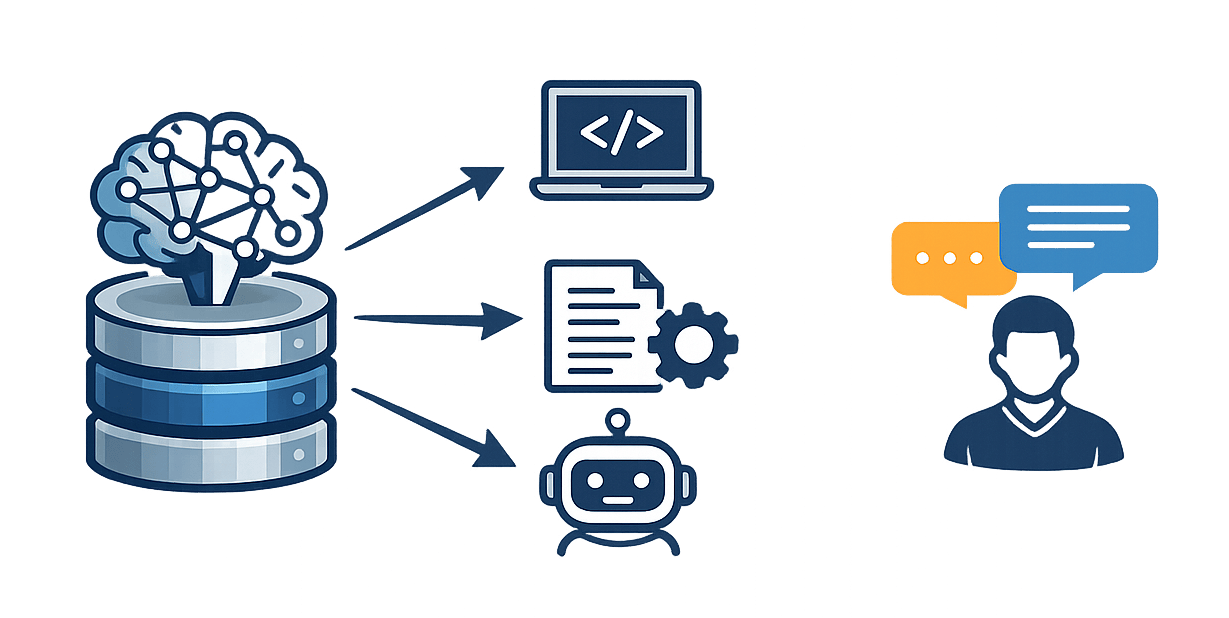
LLM Integration for Existing Products
Add AI capabilities into your current app, website, SaaS platform, CRM, ERP, admin dashboard or internal business system without rebuilding the full product.
Integrate large language models into your website, mobile app, SaaS product, CRM, admin dashboard or backend workflow. We help you add useful AI features such as summaries, copilots, document extraction, chat assistants, structured outputs, RAG and tool-connected automation.
LLM Integration Layer
Integrate OpenAI, Claude, Gemini, Azure OpenAI, open-source LLMs or a hybrid setup based on your product, budget and data needs.
Add LLM features inside websites, mobile apps, admin panels, CRMs, dashboards and backend workflows instead of shipping isolated demos.
Connect LLMs with your data, APIs, documents, rules and user permissions so outputs fit real operational requirements.
Plan logs, feedback, cost controls, fallback behavior and quality checks so your LLM integration can improve after launch.

Custom LLM Integration means adding large language model capabilities into your real software product, not just testing prompts in a playground. The model becomes part of your application, backend, workflows, permissions and user experience.
A well-built integration can summarize records, generate drafts, extract structured data, answer questions, classify requests, call tools, assist users and update workflows with the right controls.
Srishta Technology helps businesses integrate LLMs in a practical way, choosing the right model, designing the workflow, connecting data sources, building secure APIs and preparing the feature for production usage.
Most businesses do not fail because the model is weak. They struggle because the AI feature is not integrated with real users, data, permissions, workflows and measurement.
Teams test prompts manually, but the feature never becomes part of the product or daily workflow.
LLM functionality is integrated into the app, backend, permissions, logs and user experience.
The model responds without enough user context, business rules or structured output requirements.
Responses use product context, API data, documents, user roles and output formats designed for the workflow.
No clear tracking exists for token usage, bad outputs, failed requests or user feedback.
Usage, latency, quality signals, fallback events and cost are planned from the start.
Staff copy text between tools, documents, CRMs, support tickets and spreadsheets.
LLM workflows summarize, extract, draft and update connected systems through secure APIs.
We design LLM features around your product, your users and your workflows, so the output is useful inside day-to-day operations.
Add AI capabilities into your current app, website, SaaS platform, CRM, ERP, admin dashboard or internal business system without rebuilding the full product.
Create chat interfaces and copilots that help users ask questions, complete actions, search information and work faster inside your digital product.
Use LLMs to convert long records, calls, tickets, documents, consultations or operational updates into clear summaries, drafts and reports.
Extract useful information from PDFs, forms, invoices, reports, agreements, medical records or uploaded documents and push it into your workflow.
Build multi-step LLM workflows where AI reads context, decides the next step, calls tools, prepares outputs and sends work for human approval when needed.
Use open-source models when you need more control, custom deployment, private infrastructure or a cost structure that fits high-volume use cases.
A strong LLM integration needs model strategy, business context, structured outputs, monitoring, security and a clear plan for improvement after launch.
Choose the right model strategy across OpenAI, Claude, Gemini, Azure OpenAI, open-source models or hybrid routing.
Create system prompts, task prompts, response formats, tool instructions, fallback behavior and testing sets.
Connect LLMs with your backend, CRM, ERP, databases, payment systems, calendar, ticketing tools and internal APIs.
Return JSON, forms, summaries, classifications, scores, extracted fields or workflow-ready responses that your software can use.
Add document retrieval and knowledge grounding where answers need to use PDFs, policies, help centers or internal records.
Respect user roles, tenant boundaries, data access rules, PII handling and approval requirements before showing or acting on information.
Track errors, low-confidence outputs, latency, user feedback, cost, model behavior and improvement opportunities.
Reduce unnecessary token usage with caching, prompt design, routing, summaries, model selection and staged workflows.
We start with the workflow and product experience, then choose the model and integration approach that fits your technical and business requirements.
We understand the product, workflow, users, data sources, business rules and the exact outcome expected from the LLM feature.
We decide whether the solution needs a hosted API, Azure setup, open-source model, RAG layer, tool calling or a hybrid architecture.
We map where the LLM feature appears, what users can ask, what actions are allowed and what output format the product needs.
We connect the model with your backend, APIs, documents, databases, authentication, admin panel and existing product workflows.
We test with realistic cases, wrong inputs, sensitive data, edge cases, latency limits, hallucination risk and human review scenarios.
We deploy the integration, monitor usage, collect feedback and improve prompts, workflows, retrieval and model routing over time.
We connect the model with your product interface, backend, data, permissions and operations layer so AI becomes part of the software, not a separate experiment.
Business AI features need clear boundaries, permissions, human review and measurement. We plan these controls before production rollout.
LLM features should have defined boundaries: what they can answer, what they can update, when they should ask for clarification and when they must escalate.
For sensitive outputs such as healthcare summaries, financial notes, legal drafts or customer commitments, the system can route results for human approval.
The integration should use the same access controls as your application so users do not receive data outside their role, tenant or department.
A production LLM feature should track feedback, failures, cost, latency, output quality and common gaps so the system can improve.
Start with a focused workflow where better summaries, faster drafting, knowledge search or structured extraction can produce measurable value.
We choose the tools based on security, cost, latency, quality, deployment model and how the AI feature needs to work inside your product.
Our custom software, app, backend and AI delivery experience helps us integrate LLMs into real products rather than building disconnected prototypes.
Developed healthcare workflows with online consultation, lab booking, AI-generated consultation summaries, prescriptions, SOS support and admin operations.
Built AI-enabled processing workflows where model integration, backend orchestration and scalable user experience were important.
Delivered content workflows involving indexing, personalization, summaries and structured delivery across high-volume digital experiences.
Built data-driven dashboards and backend systems where AI can support summarization, reporting, classification and workflow acceleration.
Custom LLM Integration often works best with RAG, AI agents, workflow automation or enterprise assistant design.
Plan and deploy AI across business workflows, tools, data and customer experiences.
Build task-specific agents that retrieve context, use tools and complete workflow steps.
Automate repeatable operations with AI, APIs, triggers, approvals and monitoring.
Create assistants that answer from documents, websites, policies and internal knowledge bases.
Share your product, workflow and AI feature idea. We will help you understand the right model, architecture, integration scope and rollout approach.
Whether you need summaries, document extraction, AI copilots, RAG, workflow automation or model integration inside your existing platform, Srishta Technology can help you build it properly.